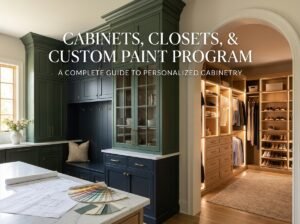
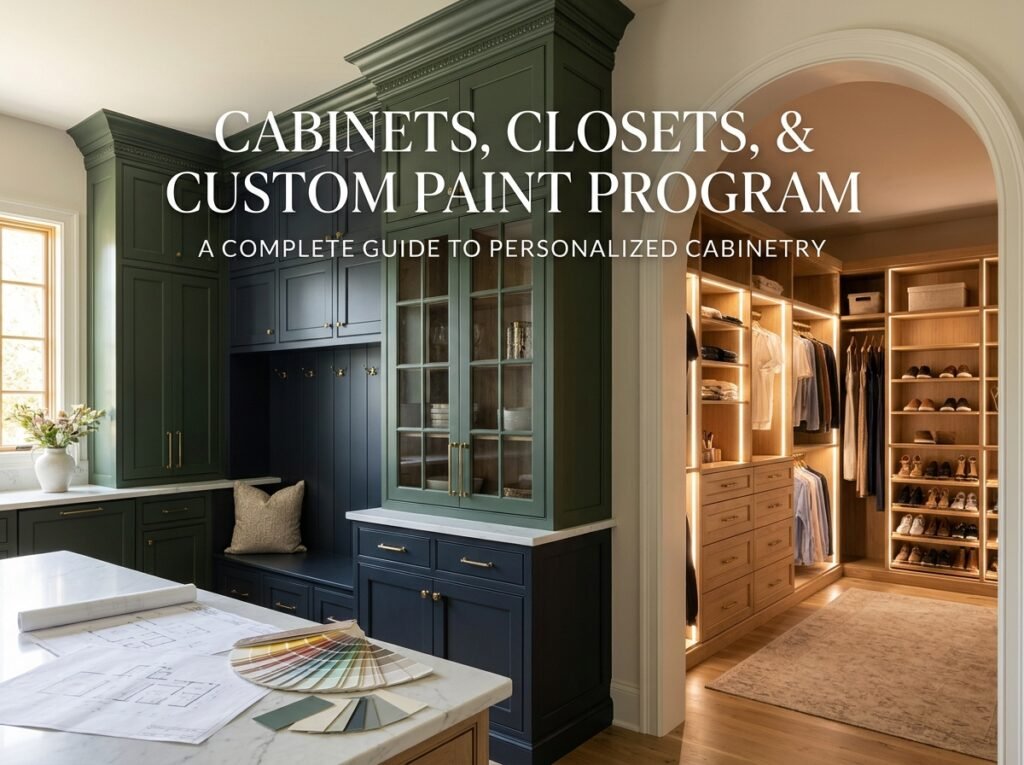
Cabinets, Closets, Custom Paint Program solutions are transforming how American homeowners, interior designers, contractors, and builders approach personalized storage and interior design. From custom kitchen cabinets and walk-in closets to professionally coordinated paint finishes, modern cabinetry offers opportunities to create functional spaces that reflect individual preferences while maintaining architectural consistency throughout the home.
Cabinetry is no longer limited to standard kitchen storage. Today, homeowners expect cabinet systems that integrate naturally into bathrooms, laundry rooms, home offices, mudrooms, entertainment centers, and bedroom closets. This growing emphasis on whole-home design has increased interest in adaptable cabinet construction, coordinated finishes, specialized storage accessories, and custom color programs.
For many residential projects, choosing the right cabinet style is only the beginning. Door profiles, cabinet materials, paint colors, hardware finishes, interior storage configurations, and installation methods must work together to achieve a practical and visually consistent result.
American cabinetry manufacturers offer a wide range of approaches to these requirements. Brands such as Fabuwood, KraftMaid, Dura Supreme, Wellborn Cabinet, Diamond Cabinets, Schrock, Omega Cabinetry, and StarMark Cabinetry provide different levels of construction and finish personalization. Meanwhile, closet specialists such as California Closets, ClosetMaid, and Closets by Design focus on organization systems tailored to specific spaces and storage needs.
Understanding the differences among these products and services helps buyers make informed decisions. Whether planning a complete kitchen renovation, organizing a walk-in closet, or selecting a custom-painted cabinet finish, the most successful projects balance appearance, material performance, functionality, and long-term value.
What Are Cabinets, Closets, and Custom Paint Programs?
Cabinets, closets, and custom paint programs are related components of residential interior design, but each serves a different purpose.
Cabinets are enclosed or partially enclosed storage structures commonly installed in kitchens, bathrooms, laundry rooms, offices, and living areas. They typically consist of cabinet boxes, doors, drawers, shelves, hardware, and decorative finishing components.
Closets are dedicated storage spaces or systems designed primarily for clothing, accessories, shoes, household items, and personal belongings. Modern closet systems frequently incorporate cabinetry features such as drawers, adjustable shelving, enclosed storage compartments, and decorative panels.
Custom paint programs provide selected opportunities to personalize cabinetry finishes beyond a manufacturer’s standard color offerings. Depending on the manufacturer, these programs may include expanded paint libraries, matching to recognized paint brands, or the development of special finishes from approved samples.
Together, these three categories support an increasingly integrated approach to interior design.
A kitchen may feature custom-painted Shaker cabinets that coordinate with a nearby pantry. The same residence might include a walk-in closet with complementary cabinetry colors, a bathroom vanity featuring a related finish, and a home office with built-in storage designed around the home’s overall color palette.
However, achieving this consistency does not necessarily mean using identical paint products throughout the residence.
Cabinet finishes must withstand repeated handling, cleaning, and everyday wear. Wall paints are formulated for different surfaces and performance conditions. A custom cabinet color may visually match a wall paint selection while using an entirely different coating system.
This distinction is particularly important when comparing manufacturers and evaluating how custom color matching works.
Why Are Personalized Cabinets and Closet Systems Important in American Homes?
Residential interiors across the United States vary significantly in architectural style, floor plan, household requirements, and storage expectations.
A historic home in New England may benefit from traditional framed cabinetry and carefully selected painted finishes. A contemporary residence in California might emphasize frameless cabinets, minimalist doors, and integrated storage. A large suburban home in Texas may require extensive pantry space, spacious closets, and durable cabinetry designed for everyday family use.
Although architectural preferences differ, the need for efficient and personalized storage remains consistent.
Customizable cabinet systems allow homeowners to use available space more effectively. Instead of relying entirely on fixed configurations, designers can incorporate organizational features that respond to how a room is actually used.
In kitchens, these features may include deep drawers for cookware, pull-out pantry units, appliance garages, waste management systems, and specialized corner storage.
In closets, personalized configurations can accommodate different clothing lengths, shoe collections, accessories, folded garments, and seasonal belongings.
Paint customization adds another dimension by helping cabinetry coordinate with countertops, flooring, walls, furnishings, and architectural features.
For contractors and professional designers, personalization also provides an opportunity to differentiate projects without necessarily requiring every cabinet component to be manufactured from scratch.
Semi-custom cabinetry can often deliver meaningful design flexibility through established cabinet sizes, modification options, door collections, and approved finishes.
The most effective solution depends on whether the project requires dimensional customization, finish customization, storage customization, or a combination of all three.
How Do Custom Paint Programs Work for Kitchen Cabinets?
A custom paint program allows buyers to select a cabinet finish outside a manufacturer’s ordinary stock color collection, subject to the manufacturer’s specific capabilities and approval process.
Some programs provide access to recognized architectural paint color libraries. Others allow designers to submit a physical sample, furniture finish, or reference color for evaluation.
The process usually begins during the design and specification phase.
Homeowners and designers identify a desired color and determine whether the selected cabinet manufacturer supports it. The color may be specified using a manufacturer name and color code, or a physical reference may be submitted when the program permits.
A cabinet manufacturer then evaluates whether the selected shade can be reproduced using its available finishing materials and production methods.
For projects requiring additional confirmation, a sample door or finish sample may be prepared.
This step is particularly valuable because color appearance can change depending on the cabinet material, coating sheen, lighting conditions, and surrounding surfaces.
A soft white that appears neutral on a small paper sample may look warmer when applied across a large kitchen. Deep blue or green cabinetry can also appear different under daylight, recessed lighting, and warm decorative fixtures.
Once a finish is approved, the manufacturer completes the order according to its production procedures.
The exact process varies substantially across brands. Not every custom color program includes sample-door production, and not every paint color is available for every cabinet material or product line.
Before placing an order, buyers should confirm:
- Whether the selected cabinet collection supports custom colors
- Which paint color libraries or matching methods are accepted
- Whether sample approval is required
- Whether custom colors involve additional charges
- Whether lead times differ from standard finishes
- Whether custom finishes are eligible for cancellation or return
- How touch-up materials and future replacement parts are handled
A well-managed paint selection process reduces uncertainty and helps ensure that the finished cabinetry matches the intended design.
Which American Cabinet Brands Offer Custom Paint Color Options?
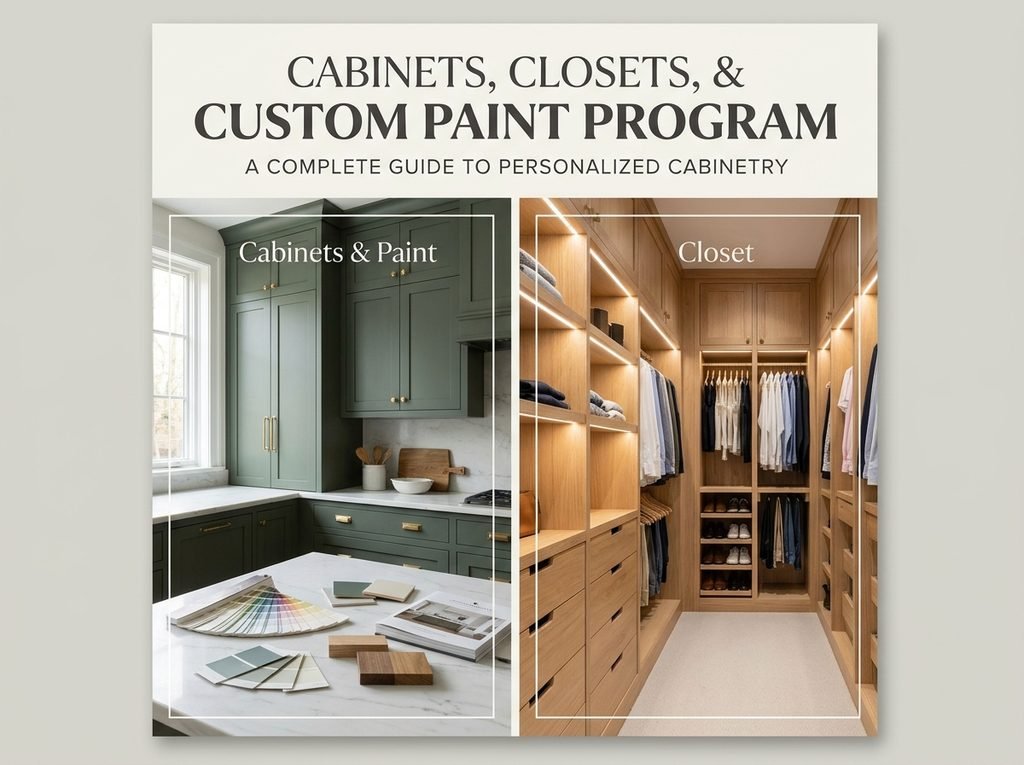
The American cabinetry market includes manufacturers offering stock cabinets, semi-custom collections, premium cabinetry, and made-to-order solutions.
Several established brands provide documented custom paint matching capabilities, while others focus on extensive curated finish collections.
Fabuwood Cabinetry
Fabuwood is a recognized cabinetry brand in the American kitchen remodeling market, offering a variety of cabinet styles and finishes.
Its cabinet collections include traditional and contemporary design influences, making the brand relevant for contractors, kitchen designers, and homeowners planning different types of renovations.
Fabuwood also offers custom color possibilities through its dealer network. Its published finish information describes customization using colors from Sherwin-Williams and Benjamin Moore.
This can be useful when a homeowner wants cabinetry coordinated with an existing interior color scheme or a specific architectural paint selection.
Fabuwood’s custom-colored cabinetry may be particularly appealing for kitchen islands, bathroom vanities, and accent cabinet installations.
However, buyers should verify which collections, door materials, and finishes are eligible before assuming a particular cabinet configuration can be ordered in any requested color.
KraftMaid Cabinetry
KraftMaid is an established American cabinetry brand associated with personalized kitchen and bathroom design.
Its cabinetry includes multiple door styles, material selections, painted finishes, and construction configurations.
KraftMaid’s ColorMatch program provides custom color coordination for eligible cabinetry selections. The brand has described matching options involving major paint manufacturers, including Sherwin-Williams, Benjamin Moore, Behr, and Valspar through specified dealer channels.
This capability allows designers to develop more coordinated interior palettes, particularly when cabinet finishes need to complement adjacent living spaces.
KraftMaid is also relevant to homeowners considering two-tone kitchens, decorative cabinet islands, and coordinated bathroom cabinetry.
As with other manufacturers, available finishes and customization options depend on the specific product line and purchasing channel.
Dura Supreme Cabinetry
Dura Supreme is especially relevant when researching personalized cabinet finishes because it offers documented programs for both paint color matching and more specialized custom finishes.
Its Personal Paint Match Program includes thousands of colors from the Sherwin-Williams and Benjamin Moore paint libraries.
The manufacturer also offers a Custom Finish Program for projects requiring an individual finish developed from a supplied reference.
These options can be useful for high-end residential interiors where cabinetry must coordinate with architectural materials, furniture, or a carefully developed color palette.
Dura Supreme’s approach also demonstrates an important distinction between selecting an existing paint color and creating a more individualized finish.
Not every cabinetry project requires full custom finishing. However, for highly coordinated interiors, a manufacturer with a documented sample approval process can offer additional design flexibility.
Wellborn Cabinet
Wellborn Cabinet is another established American cabinetry manufacturer with a broad selection of door styles, finishes, and residential applications.
Its Color Inspire offering is associated with personalized paint selections for eligible cabinetry products.
This makes Wellborn relevant to kitchen designers and homeowners who want additional color flexibility beyond a standard finish palette.
When evaluating Wellborn cabinetry, buyers should consider door material compatibility, cabinet construction, available finish options, and the specific program requirements of their chosen collection.
Diamond Cabinets and Schrock
Diamond Cabinets and Schrock provide another useful comparison for custom paint research.
Both brands publish information about their Color By Number programs, which offer selections from Sherwin-Williams and Benjamin Moore paint color families for eligible cabinetry.
These programs provide an example of how established manufacturers can offer a broad color range while maintaining defined product and material requirements.
For designers, access to familiar paint color references can simplify communication with clients and coordinate cabinetry with other interior elements.
Nevertheless, sample reviews and finish specifications remain essential because cabinet coatings can look different from ordinary architectural paint.
Other Notable American Cabinet Brands
Several additional brands are relevant to the broader American cabinetry market, including:
- Forevermark Cabinetry
- Omega Cabinetry
- StarMark Cabinetry
- Homecrest Cabinetry
- Decorá Cabinetry
- Aristokraft
- Kitchen Craft Cabinetry
- American Woodmark
- Waypoint Living Spaces
- Timberlake Cabinetry
- Shenandoah Cabinetry
- Merillat Cabinetry
- Bertch Cabinetry
- Crystal Cabinet Works
- Wood-Mode
- Brookhaven
These brands represent different product categories, design styles, purchasing channels, and levels of customization.
Their inclusion does not imply that every brand offers unrestricted custom paint matching. Some emphasize established finish collections, while others provide additional customization through selected products or professional dealers.
Buyers should evaluate the exact program offered by each manufacturer rather than treating the term “custom cabinetry” as a guarantee of unlimited color options.
Custom Paint Programs vs Standard Cabinet Finishes
One of the most important decisions in cabinetry selection is whether to use a standard manufacturer finish or request a customized color.
Standard finishes are established colors and surface treatments offered within a particular cabinet collection.
Because these finishes are part of the manufacturer’s routine product offering, they may provide more straightforward ordering, sample availability, and replacement procedures.
Custom paint programs expand color selection but may introduce additional requirements.
| Feature | Standard Cabinet Finishes | Custom Paint Programs |
|---|---|---|
| Color selection | Manufacturer palette | Expanded or specially matched colors |
| Design flexibility | Collection-dependent | Greater color personalization |
| Approval process | Usually standard samples | May require special samples |
| Pricing | Standard product pricing | Additional charges may apply |
| Production schedule | Standard lead time | May require extra processing |
| Replacement matching | Established finish reference | Custom finish records may be needed |
| Best application | Conventional and repeatable projects | Personalized design projects |
Neither option is automatically better.
For a multi-unit residential development requiring identical cabinets across numerous apartments, a standard finish may provide operational advantages.
For a highly personalized home renovation, custom color selection may be worth the additional coordination.
Homeowners should also consider whether the selected color will remain appropriate as other parts of the interior change.
Neutral whites, warm grays, muted greens, and natural wood tones can offer flexibility, but no single color works universally.
The best cabinet finish supports the room’s lighting, architecture, surrounding materials, and intended long-term use.
How Can Custom Paint Colors Transform Kitchen Cabinet Design?
Kitchen cabinets occupy a substantial portion of the visible surface area in many kitchens. Their color therefore influences the atmosphere of the entire room.
Custom paint options allow designers to move beyond conventional white and gray cabinetry while maintaining a coordinated design.
Warm white and cream finishes can complement natural stone, oak flooring, and traditional interiors. Carefully selected beige and greige tones can create a softer appearance than stark white.
Muted green cabinetry can introduce a natural character without requiring highly saturated colors.
Deep navy and charcoal finishes are often used to create contrast, particularly on kitchen islands or lower cabinets.
Some homeowners prefer stronger colors, such as terracotta, blue-gray, or dark forest green, to establish a distinctive architectural feature.
Color selection should also account for cabinet door style.
A traditional raised-panel door can look dramatically different from a flat-panel door when both use the same paint color. Decorative profiles create shadows that influence perceived color depth.
Hardware and countertop materials further affect the result.
Brushed brass hardware can create warmth against dark cabinetry, while stainless steel and chrome may contribute to a cooler visual balance.
The objective is not simply to select a fashionable color. A successful kitchen design considers how cabinetry interacts with the room as a complete architectural composition.
What Is the Difference Between Painted Cabinets and Stained Wood Cabinets?
Painted and stained cabinetry offer different visual characteristics and maintenance considerations.
Painted cabinets use a coating system that creates a relatively uniform surface color. Depending on the door material and finishing method, wood grain may be reduced or concealed.
This makes painted cabinetry suitable for homeowners seeking a consistent appearance across multiple cabinet components.
Stained cabinetry is designed to emphasize characteristics of the underlying wood, including grain patterns and natural variation.
Maple, cherry, oak, hickory, and other wood species can develop noticeably different appearances depending on the stain and finishing process.
Painted cabinetry allows greater freedom when selecting specific colors, especially through eligible custom paint programs.
Stained cabinetry is often selected when natural wood character is central to the design.
However, neither finish category is inherently maintenance-free.
Painted doors may show chips, scratches, and joint movement under certain conditions. Stained surfaces can also experience wear, discoloration, and moisture-related damage.
Material quality, coating formulation, manufacturing procedures, installation conditions, and routine maintenance all influence long-term performance.
For American homeowners comparing brands such as KraftMaid, Dura Supreme, Omega, and StarMark, the choice should reflect both appearance preferences and the specific finish performance offered by the selected collection.
How Do Custom Closets Complement Kitchen Cabinetry?
Custom closets extend the principle of personalized storage beyond the kitchen.
While kitchen cabinets focus primarily on cooking equipment, food storage, and household organization, closet systems address clothing, accessories, shoes, and personal storage requirements.
The underlying design principles are similar.
Both require efficient use of space, appropriate material selection, accessible storage, dependable hardware, and a finish that complements the surrounding interior.
A walk-in closet may include enclosed cabinets, open shelving, hanging rods, drawer units, jewelry organizers, shoe racks, and integrated lighting.
A reach-in closet often requires a more compact arrangement, with careful attention to door clearance and accessibility.
For a coordinated home interior, designers may select closet finishes that visually complement the kitchen cabinetry without requiring an exact material match.
For example, a kitchen featuring warm white cabinets and natural oak accents might be complemented by a closet system using light wood-grain panels and neutral drawer fronts.
This approach allows individual rooms to maintain their functional identity while contributing to a consistent overall design.
Which American Closet Brands Are Worth Considering?
The American closet and home organization market includes established brands offering different combinations of modular systems, design consultation, professional installation, and specialized storage accessories.
California Closets
California Closets is widely associated with personalized closet and home storage solutions.
The company’s offering extends beyond bedroom closets to home offices, pantries, garages, entertainment areas, and other residential spaces.
Its finish collections include matte surfaces, textured wood looks, and other coordinated decorative options.
California Closets is particularly relevant to homeowners seeking customized storage layouts and professionally coordinated finishes throughout multiple rooms.
Importantly, the availability of multiple decorative finishes does not necessarily mean that every architectural paint color can be reproduced through a traditional cabinet paint matching program.
Buyers should distinguish between customization of storage design and customization of painted surface color.
ClosetMaid
ClosetMaid offers modular organization solutions for different household storage applications.
Its product offerings include shelving, hanging systems, towers, drawers, and coordinated accessories.
Collections such as Style+ and other closet organization systems provide opportunities to create customized layouts using defined product components and finishes.
Modular systems can be particularly useful when homeowners want to improve storage functionality without commissioning fully bespoke millwork.
The primary advantage is configuration flexibility within the available system.
Closets by Design
Closets by Design focuses on personalized closet and home organization projects.
Its systems can incorporate a variety of storage features, door styles, drawers, organizational accessories, and decorative finishes.
This makes the brand relevant for homeowners interested in built-in closet installations with a coordinated appearance.
As with other providers, customization should be evaluated according to the available materials, finish selections, layout capabilities, and local service arrangements.
Other Closet and Storage Options
Additional companies and product categories include modular closet systems, independent custom millwork shops, and regional cabinetry manufacturers that produce built-in storage.
These alternatives may be appropriate when a project requires unusual dimensions, matching architectural trim, or integration with existing furniture.
A traditional cabinetry manufacturer may be well suited to certain built-in storage installations, while a specialized closet provider may offer greater flexibility for hanging systems and organization accessories.
Choosing between these approaches depends on the room’s functional requirements.
Can Kitchen Cabinets and Closet Systems Use the Same Custom Paint Color?
Kitchen cabinetry and closet systems can sometimes be coordinated to the same specified color, but achieving a reliable visual match requires more than selecting an identical paint name.
Different manufacturers may use different materials, coatings, sheens, surface textures, and application methods.
A paint color applied to MDF cabinet doors can appear different when used on textured laminate or wood veneer.
Lighting conditions also influence the final appearance.
A kitchen with abundant daylight may reveal undertones that are less noticeable in an enclosed closet illuminated primarily by artificial lighting.
For projects requiring a highly consistent appearance, designers should request physical samples from the actual product manufacturers.
The samples should be compared under realistic lighting conditions and placed near the materials they will complement.
When exact matching is not possible, selecting coordinated colors can be more effective than attempting to reproduce an identical shade across incompatible materials.
For example, warm white kitchen cabinets may coordinate successfully with light oak closet shelving and cream-colored drawer fronts.
This strategy creates continuity without requiring every surface to look identical.
How Should Contractors and Designers Evaluate Cabinet Paint Quality?
Custom cabinet color selection should never be separated from finish quality.
A visually attractive paint color offers limited value if the coating cannot withstand ordinary residential use.
Professional cabinetry finishing typically involves controlled surface preparation, coating application, curing, and quality inspection.
The exact procedures vary by manufacturer, cabinet substrate, and finish system.
Contractors should evaluate how well a finish resists common household conditions such as repeated cleaning, hand contact, abrasion, and occasional moisture exposure.
Kitchen cabinetry is exposed to different conditions than bedroom closet storage.
Cabinets near sinks, dishwashers, ranges, and other appliances may encounter humidity, temperature changes, and cleaning products.
Closet systems usually experience less direct moisture exposure but may face repeated contact from clothing, shoes, accessories, and sliding storage components.
Finish quality depends on several factors, including adhesion, coating thickness, curing, substrate preparation, and compatibility between materials.
For cabinets with independently certified performance, the ANSI/KCMA A161.1 standard is one recognized reference for evaluating aspects of cabinet construction and finish durability.
Buyers should not assume that a custom paint finish automatically offers greater performance than a standard manufacturer finish.
The quality of the complete coating system matters more than the uniqueness of the selected color.
How Much Do Custom Painted Cabinets and Closets Cost?
The cost of custom cabinetry and closet systems depends on the scope of the project rather than a single standardized price.
Kitchen cabinetry expenses are influenced by cabinet dimensions, construction materials, door styles, finish selections, hardware, accessories, and installation requirements.
Closet pricing depends on room size, storage configuration, shelving materials, drawer quantities, decorative finishes, and organizational accessories.
Custom paint programs may introduce additional expenses for color formulation, sample preparation, manufacturing adjustments, or specialized finishing.
However, some manufacturers integrate broad color options into established program structures, which can make certain custom selections more accessible.
Buyers should request itemized quotations that distinguish between the cabinetry package and additional services.
A complete project budget may include:
- Cabinet and closet materials
- Custom paint or finish charges
- Hardware and storage accessories
- Design and measurement services
- Delivery and freight
- Installation labor
- Decorative panels and trim
- Lighting and electrical integration
- Replacement or modification allowances
A lower cabinetry quote does not necessarily represent a lower completed project cost.
Installation complexity, material availability, and project coordination can substantially influence the final investment.
For contractors managing several residential properties, standardized designs and predictable finish selections may simplify budgeting.
For homeowners creating a personalized residence, a carefully selected custom paint finish may offer design value that justifies a higher initial cost.
How Can Builders and Cabinet Dealers Benefit from Custom Paint Programs?
Custom paint programs are not only relevant to homeowners. They also create opportunities for professional cabinet dealers, contractors, interior designers, and residential builders.
For cabinet dealers, broader finish selection can help address customer requests that are difficult to satisfy through a standard color catalog.
A homeowner may want kitchen cabinetry coordinated with an existing architectural feature or a specific interior design concept.
When a manufacturer offers documented custom paint capabilities, the dealer can present additional options without requiring an entirely independent finishing operation.
Contractors may benefit from having access to several cabinetry categories, allowing them to recommend appropriate solutions based on budget, project scope, and design complexity.
Builders can also use selected custom finishes to distinguish upgraded homes or individual units within a residential development.
However, personalization should be managed carefully.
Custom colors may involve additional ordering requirements, longer production schedules, and restrictions on returns.
For professional purchasing teams, clear documentation becomes essential.
Every order should identify the exact cabinet collection, door material, approved finish, hardware configuration, and required accessories.
Dealers and contractors should also maintain accurate customer approvals to reduce disputes involving color expectations.
The most successful custom paint programs combine design freedom with dependable purchasing procedures.
What Cabinet and Closet Design Trends Are Influencing American Homes?
American cabinet design increasingly emphasizes personalization, material contrast, and practical storage.
Rather than relying on one dominant cabinet style, many homeowners are combining familiar architectural elements with distinctive colors and finishes.
Shaker cabinets remain relevant because their balanced proportions work across numerous interior styles.
Flat-panel cabinetry continues to appeal to homeowners seeking minimalist and contemporary spaces.
Natural wood finishes are also important, particularly when designers want to introduce warmth and texture.
Two-tone kitchens provide another approach to personalization.
A kitchen may combine painted perimeter cabinets with a stained wood island, or use darker lower cabinets beneath lighter wall cabinets.
Closet design has similarly expanded beyond conventional wire shelving and basic hanging rods.
Modern systems may include integrated drawers, enclosed shoe storage, display shelves, adjustable accessories, and decorative lighting.
The relationship between cabinetry and surrounding architecture is also becoming more important.
Designers increasingly consider how kitchens, pantries, home offices, mudrooms, and closets can share complementary materials and finishes.
These approaches make custom paint and coordinated storage systems valuable design tools rather than isolated decorative upgrades.
Still, the most effective interior decisions are based on individual needs, not trends alone.
A carefully planned neutral kitchen may remain more useful to one household than a highly personalized color scheme. Another household may place greater value on expressive cabinetry that reflects its preferred interior style.
Long-term satisfaction depends on selecting solutions that remain functional and visually appropriate for the space.
Frequently Asked Questions About Cabinets, Closets, and Custom Paint Programs
What is a custom paint program for cabinets?
A custom paint program is a manufacturer’s offering that allows eligible cabinet products to be ordered in colors beyond the standard finish collection.
Some programs use recognized paint color libraries, while others accept physical references or develop special finishes.
Available colors, pricing, and approval procedures depend on the manufacturer.
Which American cabinet brands offer custom paint matching?
Fabuwood, KraftMaid, Dura Supreme, Diamond Cabinets, and Schrock are examples of brands with documented custom color or paint matching offerings.
Wellborn Cabinet also provides personalized color options through its Color Inspire offering.
Program eligibility and available colors should be verified for the specific cabinet collection.
Can custom cabinets be painted any color?
Not necessarily.
Although some manufacturers offer thousands of color choices, available colors may be restricted by product line, door material, finishing technology, or program rules.
A requested color may also require approval before production.
Are custom painted kitchen cabinets more expensive?
Custom painted cabinets may cost more than cabinets ordered in standard finishes.
Additional expenses can result from color development, sample preparation, production requirements, or special ordering procedures.
The exact difference depends on the manufacturer and project specifications.
Can closets match kitchen cabinets?
Yes. Closet systems and kitchen cabinets can be designed with identical or complementary color palettes.
However, materials and coating systems may differ, so physical samples should be compared before ordering when visual consistency is important.
What is the best material for painted cabinet doors?
MDF and selected solid wood materials are commonly used for painted cabinet doors.
MDF provides a smooth, relatively uniform surface, while solid wood offers traditional construction characteristics.
The appropriate material depends on the manufacturer’s door design, finish system, environmental conditions, and performance requirements.
What is the difference between custom cabinets and semi-custom cabinets?
Custom cabinetry generally offers greater flexibility in dimensions, construction details, and design specifications.
Semi-custom cabinetry uses established product collections with selected modifications and finish options.
Either category may include personalized colors, depending on the manufacturer.
Are custom paint programs available for bathroom cabinets?
Many cabinet manufacturers extend eligible finishes and paint options to bathroom vanity cabinetry.
However, bathroom environments require appropriate consideration of moisture exposure, ventilation, and material performance.
Buyers should confirm that the chosen cabinet system is suitable for its intended application.
How long does custom painted cabinetry take to manufacture?
Production time varies according to the manufacturer, product collection, finish approval process, order complexity, and manufacturing schedule.
Custom colors may require additional processing compared with standard finishes.
Buyers should obtain a current project-specific lead-time estimate before scheduling installation.
Are custom closets worth the investment?
Custom closets can be valuable when they improve storage capacity, organization, accessibility, and everyday convenience.
Their suitability depends on household needs, installation costs, available space, and the quality of the selected system.
A well-designed closet should prioritize functional organization rather than decorative features alone.
Choosing Cabinets, Closets, and Custom Paint Programs for Lasting Value
The growing variety of Cabinets, Closets, Custom Paint Program solutions gives American homeowners and industry professionals greater flexibility when planning functional and personalized interiors.
Kitchen cabinetry, bathroom storage, built-in furniture, and custom closet systems can work together to create spaces that feel organized, visually balanced, and appropriate for everyday life.
Established cabinet brands such as Fabuwood, KraftMaid, Dura Supreme, Wellborn, Diamond, Schrock, Omega, and StarMark demonstrate the diversity of the American cabinetry market. Specialized closet providers, including California Closets, ClosetMaid, and Closets by Design, further expand the available storage design possibilities.
However, brand recognition alone should not determine the purchasing decision.
Material specifications, finish quality, dimensional requirements, hardware performance, product availability, installation practices, and long-term maintenance all deserve careful consideration.
Custom paint programs can provide meaningful design freedom, especially when homeowners want cabinetry coordinated with architectural finishes or personalized color schemes.
At the same time, standard manufacturer finishes and complementary closet materials may offer excellent results without the complexity of special color matching.
The most effective approach is to evaluate the entire project rather than selecting cabinetry, closets, and finishes independently.
By balancing practical storage requirements with carefully selected materials and coordinated colors, homeowners, builders, and designers can create interiors that remain attractive, functional, and adaptable for years to come.